Saturday, 8 October 2011

Fabulous Beast's "Rian" and Donka: A Letter to Chekhov

Rian and Donka: a Letter to Chekhov

(previously posted on keestone.livejournal.com)

This evening, I got a standby ticket to see Fabulous Beast Dance Company's Rian. I'm glad I didn't drag anyone with me. 

Now don't get me wrong, Fabulous Beast is a very good ensemble of dancers.  I have no gripes with their technique or artistry.  And there were some excellent pieces within the concert as a whole.  But I think the concept behind Rian was fundamentally flawed, it lacked anything other than the concept to unify it, it was static, disconnected, and at least 45 minutes too long.  I got bored.  And if I of all people get bored watching dance, that's a bad sign.

I suspect I'm a bit synaesthetic in my physical response to the shape of music. It's probably why I'm so passionate about dance.  When I listen to music I love, I love to close my eyes and watch it take shape, watch it dance.  (I nearly had a fit when I saw the Fantasia 2000 "Rhapsody in Blue" set-piece. Can't they hear that's a curved line?!?)  It's also probably why I so vehemently hate some music. I mean, I can't listen to distorted electric guitar because it makes me physically ill, and I don't feel like I'm exaggerating when I talk about certain repetitive heavy beats being the equivalent of hitting me in the head with a baseball bat over and over.  So when it comes to dance, I get pissy when the the movement doesn't fit with the sound.  I got pissy this evening -- not at every piece, but enough to make me less appreciative of the very good dancing.  The concept of the piece was generally flawed in this.  Rian  mixed Modern dance with Irish Trad. music.  Occasionally it worked --  when the music wasn't actually Trad. music for instance, or in some slower, Sean-nos style songs (one of which was beautifully choreographed with three women mostly moving very little except for their arms, while one woman moved more) -- but mostly it didn't.  There's a very good visual equivalent of the "diddly-idly" jigs and reels, and that's the stiff, percussive movement of traditional Irish step dancing.  Not that I want a repeat of Riverdance for a concert performance of dance to Irish music, but the curved, smooth, breath-movements paired with the jigs and reels made me feel like they got the wrong place and the dancers should have been at a Jefferson Airplane concert at the Fillmore, but they somehow got plunked down in a trad. session while still hearing the psychedelic rock.   Except for that one point when I really really wanted the couple dancing to just break into a Lindy Hop, because they had the perfect swing and partnership for that even if the music had nothing to do with it.

So, I got pissy.  And then I got bored.  The choreography lacked dynamism. It was very much one level. The evening overall didn't have any structuring movement; it was just a concert, a bunch of songs thrown together.  For two hours.  Without intermission.  I started checking my watch about an hour in, but I had no idea when it was ever going to end because there was no build, no climax, just another song starting.  Some things might have worked better if they'd been before or after other things, but in any case there was entirely too much of the "music starts, one person starts a repetitive series of movement, another person runs up and joins in, wash, repeat.  As in, like half of the choreography was that.  Yawn!  And then there were a few absolutely beautiful moments, and I got pissy because the rest of it could have been of that caliber but it wasn't.

That's enough of that.

Last Saturday, was Donka: A Letter to Chekhov, which really only had tenuous connections to Chekhov but was beautiful, spectacular, and really enjoyable.  It basically mixed the kind of acrobatic performances you'd see in something like Cirque du Soleil with clowning (of the more traditional commedia-inspired action, not of the painted faces . . . although there were big shoes at one point), with some absolutely stunning set-pieces and shadow play.  Its only real flaw in my opinion, was that there was a bit too much talking, part of which was trying to a more clear connection to Chekhov. Just give me the pretties!

But here!  a video!


And that's it for now.

Friday, 7 October 2011

16 Possible Glimpses -- Marina Carr

(previously posted on keestone.livejournal.com)

So.  16 Possible Glimpses.  The first night of actual performances.  Not opening night, but the first preview performance of the world premiere, so there will probably be some changes still.  What do I think? As often happens with Marina Carr's plays, I come out thinking I really need to contemplate it more and wanting to see it another time before I can really say something meaningful.  There's always so much in them.  They're dense, in a good way.  Richly layered and highly symbolic, leaving me with a feeling of depth and power.  It's "a series of dialogues and domestic scenes" rather than a more traditionally written play with a linear plot and unified narrative, so it takes up until nearly the end for the shape of the play to reveal itself.  The first scenes and last scenes link and you come full circle.

16 Possible Glimpses has been 10 years in the works.  Beloved thinks it's the best Marina Carr play he's seen yet.  (I'd probably lean more towards Woman and Scarecrow for its sheer power and poetry. But, I think 16 Possible Glimpses would probably balance very well with Woman and Scarecrow as two sides of facing death.) It's definitely more accessible than some of her other work.  I mean, it's a Marina Carr play without incest and/or suicide.  It's gentler than most of her other plays.  It's beautiful, tender, and full of humour. and it's more clear than ever that she sees death as very much a part of life, not as an ending.  There is a soul-guide character in this play, like the Ghost Fancier in By the Bog of Cats or Scarecrow in Woman and Scarecrow, but Chekhov's Black Monk is even more clearly a friend.    It's very clear that she loves Chekhov, and that she sees him as a great soul.  That would have been obvious even if we hadn't attended a talk before the play in which she totally geeked out about Chekhov in interview.

Technically, it's very interesting.  In the pre-show talk, Carr made it very clear that the title is non-literal.  "Why 16 Possible Glimpses?  I like the number 16, I like the word possible, I like the word glimpses."   There aren't sixteen scenes, there aren't sixteen cast members, it was just a number she liked for the title. She focused a lot on the word "possible" as a reminder that she wasn't writing a literal biography either, but a response to "her" Anton Pavlovich Chekhov  (I like "her" Chekhov").  But the "16" and "Glimpses", I think, come into the technical side of things.  16 is a nice, large number for plurality, and what Carr and director Wayne Jordan have done is give you multiple visual perspectives using cameras projecting different angles of what is happening on stage on the backdrop and occasionally on a scrim in front of the action.  16 may not be literal, but we were definitely literally given multiple possible glimpses.  Sometimes it worked better than others, and some of the cut scenes were a bit distracting, but some of those will probably have been ironed out by the time previews ended.  Sometimes it was stunningly effective dramatically speaking.   On a bit of a tangent, there seem to be two emerging trends at the festival this year: site-specific theatre, and the use video projectors (blah blah blah multimedia experience).  I'm a little resistant to both, not because I think they're a bad thing, but currently they seem to be way too faddish. And like many things that are faddish or overused, they're often used to use them and not because they are the best technique for the desired effect.  And often, the logistics are just not thought out well enough and it distracts from the effect.  Here, though, the use of projected video really did seem integral, and it I think it added layers and depth to the overall experience.

Thursday, 29 September 2011

The Lulu House - Dublin Theatre Festival 2011

(previously posted on keestone.livejournal.com)

The Dublin Theatre Festival has opened, and  my sister-in-law and I have seen our first of the season.  The Lulu House, featuring Lorcan Cranitch and Camille O'Sullivan, and directed by Selina Cartmell (who directed, among other things I've been blown away by, both Woman and Scarecrow and the production of Sweeney Todd we saw at The Gate).

It's on the more experimental side of things, since it's a site-specific, "immersive experience" that mixes acting, music, projected video, and installation.  It ranged all over the James Joyce House (The Dead), as we followed the actors from room to room for different acts.  A lot of it involved the two actors reenacting scenes from a film starring Louise Brooks while the same scenes were projected into the room, with the audience gradually coming to a deeper understanding of the circumstances that this was happening in.

So, The Lulu House is about voyeurism and the violence of obsession.  And as it's immersive theatre, it's trying to make you the audience feel complicit as a voyeur to a crime as one who stands and watches victimization, who is invited into the scene by a man who wants to show you his "presentation"about Louise Brooks.  You start in the sitting room on the ground floor, moving to the hallway, and thence to increasingly intimate and disturbing spaces and scenes, eventually ending up in the cellar (and then out the front door).

It was really well-performed, beautifully designed, and disturbingly creepy, and oh so close.  Unfortunately, it didn't quite work.  A couple of the problems were logistical.  There were too many audience members.  The "limited audience" was just plain not limited enough. It's not an immersive experience when you're distracted by trying to duck around shoulders to see what's going on, and getting stepped on is the wrong kind of immersive experience.  The other thing was getting us from room to room -- the actors had to do the herding as well as portraying their characters, and sometimes it stood out awkwardly, diminishing the intensity of emotion.  And, it was pretty emotionally intense when logistical problems weren't getting in the way, and as you figured out what was going on.Sis-in-law pointed out afterwards that there was actually a simple way to do this without confusing things:  a plant.  If they'd just had one "audience member" to go where we were supposed to go next, the rest of us would have followed like sheep no problem.  You wouldn't have had to have Cranitch's character in particular trying to call "Louise" on to come upstairs, etc.

Another thing was that I could see exactly why the episodes or acts were ordered the way they were ordered, but it ended up feeling a bit too contrived . . . a bit of a cop out.  Although, it did end up with one of the weirdest ways to end something I've ever experienced, as we all followed O'Sullivan's character out the front door, watched her cross the street and walk across the bridge into the distance . . . and then stood around not entirely sure if that was it, eventually deciding that we'd been told it was exactly an hour long, and it had been an hour so it must be over.

Anyhow, here's a blurb from the Theatre Festival's website:

"THE LULU HOUSE is inspired by George Pabst’s masterpiece Pandora’s Box,
the 1920’s silent film starring Louise Brooks, and German playwright
Frank Wedekind’s 19th century ‘Lulu’ plays.  This immersive experience
will take you on a shocking, thrilling and intoxicating journey
exploring how Lulu has eluded and seduced, spreading desire and
destruction wherever she goes and offers a unique opportunity to get up
close and personal with the amoral psyche of this seductive femme
fatale."


 I'm very glad I just went "Oh!  Selina Cartmell's directing that.  I want to see it!" and didn't bother reading the blurb too deeply until after seeing it . . . because that blurb is really misleading.  It's not about Lulu, it's about obsession with Lulu.  And psychotic obsession is not the same thing as "seduction".  That's what we call victim blaming.
It wasn't completely satisfactory, but I'm glad we went.

Tuesday, 21 June 2011

Le Sacre du Printemps -- The Polish National Ballet, Warsaw


Three different versions of The Rite of Spring -- a performance of Millicent Hodson's  reconstruction of Nijinsky's original choreography, a contemporary version by Emanuel Gat that premiered in 2004, and  Maurice Béjart's version that premiered in 1958.  The company, the Polish National Ballet, was excellent, and the programme was well conceived and fascinating.  It was inspiring to see, as well as extremely interesting.  The angular movement, the Primitivism, yeah.  The celebrated rioting at the premiere wasn't caused by the music, it was the choreography and design.   The Primitivst elements are very much of their era, but the movement seems very contemporary.  It was like I was both watching a piece of history, one of those moments where everything changed, and seeing how near we are to it..


Gat's revisioning was very interesting, but it didn't fully work.  The piece used only five dancers -- two men and three women.  The men were in tightly tailored shirts and trousers, the women in Little Black Dresses.  The set, rather than the lavish, pastel colored backdrop paintings, was plain with the stage mostly dark, lighting focused on a red rug on the middle of the stage.  The five dancers interwove with each other, in ballroom dance-inspired movement, changing partners in an updated, urban, "civilized" mating ritual.  It was ingenious at times, and sometimes the contrast of simple walking or sinuous movements with Stravinsky's rhythms gave an extra sinister level to the movement.  But, it didn't go beyond that and the concept ended up falling flat without a movement from the fertility ritual to the violence or any culmination.  There was no separation between the two acts, and the movement continued without any resolution.  Maybe that was the point --  that modern rituals are lacking in life-force -- but as much as I wanted the concept to work as a whole, it felt forced and too small.  Maybe adding dancers and building could have helped.  Again, though, the dancing was excellent.
(YouTube video is of Gat's choreography, not the production I saw.)


And then there was Béjart's version.  Unlike Gat's it took the themes and concepts in the original, abstracted them, and made them more universal.  Successfully.  And completely musically.  And it added more in the way of gender commentary.  The two acts were separated, with the first act all men, the second act women.  The tribal rituals of a society, in which solidarity and dominance are asserted by choosing a scapegoat who fails to completely fit in in the gender play, ostracizing them, and making sure that mating happens between approved members . . . yeah.  In the simple costumes of various colors (leotards for women, unitards for men, the scapegoats in white), it was clear that this isn't just "Primitive" ritual, this is the way society is still working today.  The same movements of human sacrifice to keep the tribe under control, with whatever reasons or beliefs behind that . . . and it worked so well with the music.  The only distraction from the work of art as a whole, was that the female scapegoat was so thin she was almost skeletal. And ye gods, seeing twenty-two excellent male dancers on stage together in choreography of that power and depth is something special.  From what I saw, the company focus less on "star" quality than on a troupe that works as a single body.  This may be due to the more ensemble nature of the works we saw rather than the company itself, but it seemed like everyone was soloist quality and everyone was on equal ground with little difference between corps and soloists other than who was dancing.

Saturday, 14 February 2009

Marble by Marina Carr

(previously posted on keestone.livejournal.com)

 So today, we got to see the newest Marina Carr play at the Abbey Theatre . . . the world premiere of Marble.  I have said this before and I'll say it again, I truly do think that Marina Carr is the best living playwright writing in the English language.  I absolutely adore her work, and Woman and Scarecrow, which I saw last year, is one of the most powerful theatrical experiences I have ever had.  (I think it's a photo finish between Woman and Scarecrow , Floyd Collins, and the production of Mother Courage and her Children that I saw when I was sixteen.)

Marble is the first of Carr's plays I've seen that is urban in setting.  In a way, it's less violent than her earlier plays, but it is no less unforgiving, intense and essentially human.   If I were to try to give it a weird blurb, I'd say it's a strange cross between Woman and Scarecrow and A Doll's House with Yuppies.  Woman and Scarecrow was an intensely psychological, intensely symbolic play -- a divine play in many ways; Marble contains the same urges and similar themes, but juxtaposes them with the ordinary, the "rules and regulations" -- written and unwritten -- of everyday urban life with all its compromises and relationships between people --  Two businessmen, Art and Ben, who are old friends, and their respective wives Anne and Catherine.  Art and Catherine share a dream of making love in a room of marble, and the destructive power of the subconscious urges toward something more than their ordinary lives begins to take over conscious daytime life, with its everyday, regulated dying by degrees, its social roles and responsibilities and jealousy.  It echoes the still-modern themes of A Doll's House with the question of the individual and society; with the reminder of a parent's responsibility to their children; and the refrain that the world outside the family home and the safe if restrictive social structures is cold, unfriendly, and perhaps impossible to survive.  Yearning after something more destroys what is.

Carr displays herself and her language like a virtuoso in this play.  Her ever poetic, symbolist language sits almost strangely in the mouths of characters in quotidian grey suits and 'sophisticated house mom' slacks and heels.  The juxtaposition is a reminder that there could be more depth to life than Anne's regimented three glasses of wine before bed or Art's continual brandy and cigars after work -- that somewhere buried in them, there is something more to yearn after.    There are "catch it if you can" references to some of her earlier plays.  A conversation between Ben and Catherine about a play Catherine has bought tickets to dismisses what sounds awfully like Woman and Scarecrow:  "I forget the name of it . . . about the auld one dying" / 'Auld ones dying don't interest me.  Women who've stopped ovulating should die offstage.  Who cares?". . . , while at another point Anne is reading a French novel about "tasteful incest" which immediately made me think of Portia Coughlan (which does indeed deal with incest -- and suicide --  tastefully, though it is definitely not French). 

I came out of the play wanting to see it again as well as wanting to buy the script as soon as it is published.  Because, I feel there is much more in it than anyone would be able to catch the first time around.  Marble is an opaque symbol. 

Sunday, 2 March 2008

Playing "why does s/he look familiar"? and other personal reactions to plays

(previously posted at keestone.livejournal.com)

About four years ago, I saw a wonderful production of Philadelphia Here I Come, which was excellent timing, since I was studying Brian Friel that semester.  I loved the play, but I found it somewhat derivative.  See, I absolutely love The Glass Menagerie, and I saw a great deal of Tennessee Williams' influence in Philadelphia Here I Come.

Today, I saw a wonderful production of The Glass Menagerie.  I almost laughed when the Gentleman Caller walked on stage, though.  It was Private Gar.


Speaking of laughter, this is the second seriously dramatic play I've seen at The Gate that the rest of the audience audience seemed to find much more funny than I did.  It's kind of weird to hear people laughing at moments that you find painful.  The other play that this happened in was Uncle Vanya.  Part of this was Brian Friel's translation, which I didn't particularly like.  It played some moments for broader humor rather than what I remembered as more cynical and fatalistic, and it seemed to be trying to make Uncle Vanya an Anglo-Irish Big House play.   It was one of the less satisfactory productions I saw during the Dublin Theatre Fetival.  It was still very good, mind.  Vanya and Sonia were both excellent.  But, I preferred the other translation I'd seen before, Yelena seemed to have wandered in from a Noel Coward play, and I found Astrov a wholly unlikable ass, where I'd previously found him the most sympathetic character.

Speaking of somewhat off characterization...  While the production of The Glass Menagerie I saw today was excellent and all the actors were wonderful, I felt that Laura was miscast.  A couple of the other people in the group I went with had the same thought . . . she wasn't fragile enough.  It was more than that though.  It's hard to express this . . . she was too extroverted.  Too expressive, almost.  (I suppose that it also didn't help that she looked like Wynona Rider.)  The actor was really really good, and she gave a beautiful performance, but it just didn't fit quite right.  It bugged me, and it was personal.  See, Laura is the first character I really, really touched.  I haven't played her in a full production, but I've played her in scenework, and I did do the scene with Jim in a student showcase.  It was a meaningful experience.  I've always identified a little too closely with Laura Wingfield.  (Amusingly enough, my knee seized up during the play, so I ended up limping out of the theatre at the end.)

Monday, 22 October 2007

'It is never easy becoming the past tense." -- Woman and Scarecrow


(originally posted to keestone.livejournal.com)

It's rare enough that on seeing the first half of a play, you just know that you have to buy the book as soon as possible.  Luckily, the Abbey and Peacock theatres tend to sell copies of the plays they're intimately involved with, so I was able to buy the script for Woman and Scarecrow during intermission.  Marina Carr is a playwright with an uncompromising sense of humanity and Woman and Scarecrow is an unforgivingly powerful play -- a play that hits so hard that applause feels out of place.  Out of all the wonderful theatre I've seen in the past three weeks, I think this is the play that will stick with me.

Woman and Scarecrow is a threnody for a bitter and unhappy woman.  Yet of the plays I've experienced recently, this is the one that offers catharsis.  It is intensely poetic, a play that first stuns you then seeps into your consciousness leaving you pondering scenes for days afterwards.  Several critics have connected the play to Dylan Thomas' most famous villanelle.  Another work sparking connections for me is Tolstoy's The Death of Ivan Ilyich.  This production is the Irish premiere of the play, which had its world premiere last year in London.  Looking at the publicity stills from the London production reminds me how much a collaborative artform theatre is.  The design and direction ( the director was Selina Cartmell, whose Sweeny Todd I ecstatically squeed about a few months ago) illuminated Carr's script.

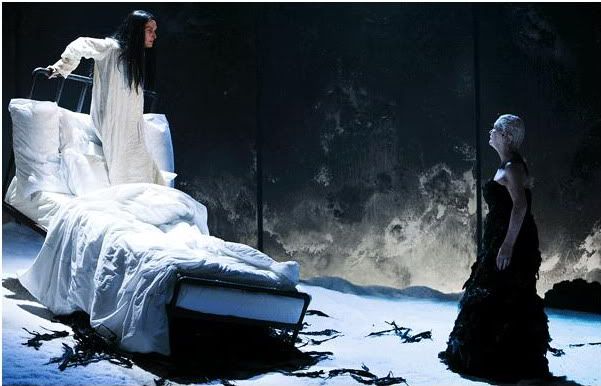
  The play begins with a young girl in a red coat and hat playing in the snow projected onto a scrim.  The scrim rises to reveal the Woman, on her deathbed, watching her younger self now spectrally projected onto the bleak symbolic landscape of the stage.  The set is stark-- Woman's deathbed is perched precariously on a snowdrift, and the walls are dark and foggy.  Woman converses with her alter ego, Scarecrow, while death waits in the wardrobe.
Woman and Scarecrow -- Olwen Fouere, Barbara Brennan
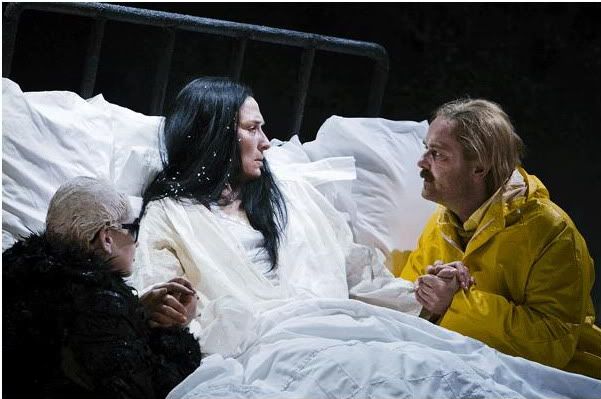
   Their conversation is periodically intruded upon by her unfaithful husband ("There are many ways to leave someone.  Mine is a cliche. I lack your savagery.")  and by her Auntie Ah (the representitive of a whole cadre of relations either keeping vigil or a more vulture-like deathwatch).  Unlike the stark blacks and whites of Woman's interior landscape, the intrusion of humanity is bright and garish.  Despite her fight to stay living for a little while longer, Woman seems to shun her connections with the outside world.  Her interactions with Him and Auntie Ah are only half focused, as Scarecrow still holds her attention.  While her eight children are often mentioned, they are never seen and are often mentioned as excuses or shields (with the exception of the ninth child, who died unborn).
Woman and Scarecrow -- Barbara Brennan, Olwen Fouere, Simon O'Gorman

Half the critics reviewing Woman and Scarecrow end up quoting Dylan Thomas's "Do not go gentle into that good night," and for good reason.  Olwen Fouere's performance is stunning, and she does indeed rage as everything is stripped down to the nakedness of facing death.  Her Woman is bitter and unforgiving, desperately vulnerable, and at times tender.  Barbara Brennan's Scarecrow is a perfect partner, balancing wry humour and equal unforgiveness ("Why didn't I have more sex when I could have?"  "You were too busy hoovering.") with the glamour of an alter ego who accuses Woman of sacrificing herself to mediocrity, the tenderness of Woman's only connection to her dead mother and the sinister mystique of Thanatos.  The young girl in the red coat and hat, an image that Woman holds as a memory of a moment of happiness and connection with her mother, is revealed to be a false memory covering the moment of connection the girl had with her mother on her deathbed. 
". . . as I stand there . . . a terrible realization comes flashing through . . . a picture from the future . . . as I stand there, I see myself here.  Now.  I see my own death day . . . and now she wakes and looks at me.  I swim in her eye, she in mine, we're spellbound, unsmiling, conspiritors too wise to fight what has been decreed on high long ago."
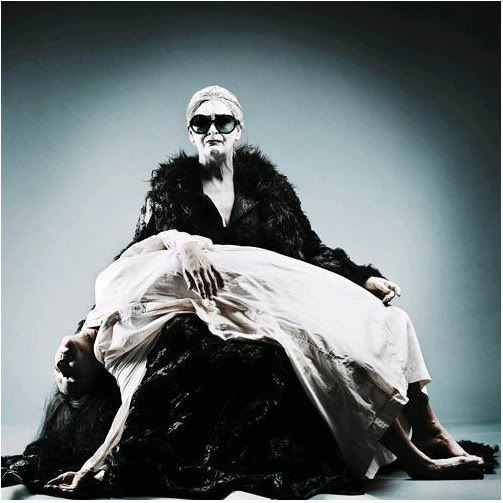
Scarecrow's role turns from that of the alter ego helping her fight death to death's angel.  As Woman reaches the moment of her death, she is unclothed, cut off even from her deathbed.  The play ends with a stunning echo of the Pieta.


Woman and Scarecrow
(Publicity shot.)


I just have to include a last monologue . . . I'm just too glad to have the text, I guess.
"We don't belong here.  There must be another Earth.  And yet there was a moment when I thought it might be possible here.  A moment so elusive it's hardly worth mentioning . . . an ordinary day with the ordinary sun of a late Indian summer shining on the grass as I sat in the car waiting to collect the children from school.  Rusalka on the radio, her song to the moon, Rusalka pouring her heart out to the moon, her love for the prince, make me human, she sings, make me human so I can have him.  And something about the alignment of the sun and wind and song on this most ordinary of afternoons stays with me, though what it means is beyond me and what I felt is forgotten now, but the bare facts, me the sun, the shivering grass, Rusalka singing to the moon.  And I wonder is this not the prayer each of us whispers when we pause to consider.  Make me human.  And then divine.  And I wonder is it for these elusive prayers we are here, these half sentences that vanish into the ether almost before we can utter them.  Living is almost nothing and we brave little mortals investing so much in it."